- May 13, 2026
- By Joint Care London
Tennis Elbow (Lateral Epicondylitis) - Causes, Symptoms and Treatment
Tennis elbow is one of the most common musculoskeletal conditions seen in clinical practice — yet its name is misleading. Despite the association with sport, fewer than 5% of people with tennis elbow actually play tennis. The condition affects an estimated 1–3% of the adult population, peaking in those aged 35–54, and is just as likely to develop from typing, painting, gardening, or any activity involving repetitive gripping and wrist movement.
The good news is that tennis elbow is very well understood, and the vast majority of patients can achieve full recovery with appropriate treatment. At Joint Care London, we assess and treat tennis elbow at our clinics in Notting Hill and Golders Green, offering rapid access to expert clinical assessment and a full range of injection therapies — all performed under ultrasound guidance.
What Is Tennis Elbow?
Tennis elbow — known clinically as lateral epicondylitis or, more accurately, lateral epicondylalgia — is a condition affecting the tendons that attach the forearm extensor muscles to the bony prominence on the outer side of the elbow, known as the lateral epicondyle.
The primary tendon involved is that of the extensor carpi radialis brevis (ECRB), one of the muscles responsible for extending and stabilising the wrist. Repetitive loading of this tendon — particularly with the elbow in extension and the wrist being extended against resistance — causes microscopic damage within the tendon tissue. When the rate of damage exceeds the tendon's ability to repair itself, a degenerative process sets in.
Importantly, research over the past two decades has shown that tennis elbow is primarily a degenerative tendinopathy rather than an inflammatory condition — despite the "-itis" suffix in its traditional name. Biopsy studies of affected tendons reveal disorganised collagen fibres and abnormal blood vessel ingrowth (a process called angiofibroblastic dysplasia), rather than the inflammatory cells typically associated with true inflammation. This distinction has important implications for how the condition is best treated.
What Causes Tennis Elbow?
Tennis elbow develops when repetitive stress on the extensor tendons of the forearm outpaces the tendon's ability to recover and remodel. Several factors contribute to this imbalance:
- Repetitive gripping and wrist extension: Any activity requiring repeated gripping, twisting, or lifting with the wrist extended places sustained load on the ECRB tendon. Common triggers include racket sports, manual trades (carpentry, plumbing, painting), keyboard and mouse use, cooking, and gardening.
- Sudden increase in activity: Starting a new physical activity or significantly increasing the volume or intensity of an existing one — such as a new exercise routine or a prolonged DIY project — can overwhelm tendon adaptation capacity.
- Poor technique or equipment: In racket sports, using an ill-fitted racket (wrong grip size or string tension), poor backhand technique, or playing with a heavy ball are well-recognised contributing factors.
- Age-related tendon changes: Tendons become less resilient and slower to repair from the mid-thirties onwards, explaining the peak incidence in the 35–54 age group.
- Muscle weakness or imbalance: Weakness in the forearm, wrist, or shoulder musculature alters load distribution and increases stress on the lateral elbow tendons.
- Dominant arm: Tennis elbow affects the dominant arm in the majority of cases, consistent with its association with repetitive use.
Symptoms of Tennis Elbow
The symptoms of tennis elbow are usually distinctive and recognisable, though they can range from a mild background ache to severe, debilitating pain that limits even basic daily tasks.
- Outer elbow pain: The hallmark symptom — a localised ache or sharp pain directly over or just below the lateral epicondyle (the bony bump on the outer side of the elbow). The pain may radiate down the forearm.
- Pain with gripping: Discomfort or weakness when gripping objects — a cup, a door handle, a pen, or a shopping bag. Many patients describe the grip feeling unreliable or suddenly painful.
- Pain with wrist extension: Lifting or pulling with the palm facing down (pronated grip) is typically more provocative than lifting with the palm facing up.
- Morning stiffness: The elbow may feel stiff and uncomfortable first thing in the morning, loosening with movement.
- Tenderness on palpation: Direct pressure over the lateral epicondyle or the ECRB tendon origin reproduces pain — a finding that clinicians use to confirm the diagnosis.
- Weakness: Reduced grip strength on the affected side is common, sometimes even without pain.
- Symptom-free at rest: In most cases, symptoms are provoked by activity and subside with rest — particularly in the earlier stages of the condition.
How Is Tennis Elbow Diagnosed?
Tennis elbow is primarily a clinical diagnosis — meaning it can usually be confirmed through history-taking and physical examination alone, without the need for immediate imaging.
Clinical Examination
A clinician will assess the elbow for tenderness over the lateral epicondyle, test resisted wrist and finger extension, and evaluate grip strength. Several specific clinical tests help confirm the diagnosis:
- Cozen's test: The patient attempts to extend the wrist against resistance while the elbow is extended — reproducing pain at the lateral epicondyle.
- Mill's test: Passive stretching of the wrist into flexion with the elbow extended and forearm pronated provokes pain at the lateral epicondyle.
- Grip strength testing: Reduced grip strength on the affected side, particularly with the elbow extended, is a consistent finding.
Ultrasound Imaging
Diagnostic ultrasound is a highly valuable tool in the assessment of tennis elbow. It can identify tendon thickening, hypoechoic areas (representing degenerated tendon tissue), calcific deposits, and abnormal blood flow (neovascularity) within the tendon — confirming the diagnosis, assessing severity, and guiding treatment decisions. At Joint Care London, ultrasound is used both diagnostically and in real time to guide all injection procedures.
MRI
MRI is occasionally requested when the diagnosis is uncertain, when symptoms are atypical, or when surgical planning is being considered. It provides detailed images of the tendon, adjacent muscles, and the lateral elbow ligament complex — the latter being important to assess in patients who also have lateral elbow instability.
Conditions to Rule Out
Lateral elbow pain is not always tennis elbow. Other conditions that can cause pain in this area include:
- Radial tunnel syndrome: Compression of the radial nerve as it passes through the radial tunnel, causing pain and sometimes weakness in the outer elbow and forearm. Often co-exists with or mimics tennis elbow.
- Lateral elbow ligament laxity or instability
- Osteoarthritis of the elbow joint
- Referred pain from the cervical spine (neck)
- Posterior interosseous nerve entrapment
A thorough assessment will differentiate tennis elbow from these alternative diagnoses, ensuring the right treatment is directed at the right structure.
How Long Does Tennis Elbow Last?
Left untreated, tennis elbow is often a self-limiting condition — but "self-limiting" should not be mistaken for "quick to resolve." Studies suggest that without intervention, the majority of cases resolve within 12–18 months. However, the recurrence rate is significant, and many patients experience persistent or relapsing symptoms over several years, particularly if the underlying activity load is not modified.
With appropriate, timely treatment, most patients achieve meaningful improvement within 6–12 weeks and full recovery within 3–6 months. The duration of symptoms before treatment begins is one of the strongest predictors of recovery time — making early intervention worthwhile.
Treatment Options for Tennis Elbow
Treatment for tennis elbow is guided by symptom severity, duration, and the degree to which the condition is interfering with daily life and work. A stepwise approach — starting with the least invasive measures and escalating as needed — is standard practice.
1. Activity Modification and Load Management
The first and most essential step in managing tennis elbow is reducing the repetitive load that is driving tendon damage. This does not necessarily mean complete rest — in fact, complete rest is counterproductive, as tendons require some degree of loading to stimulate repair. The goal is to identify and modify the specific activities that provoke symptoms, rather than stopping all activity.
- Identify and temporarily reduce provocative activities (gripping, lifting, wrist extension under load)
- Modify technique for occupational tasks or sporting activities
- Adjust equipment — for racket sports, consider grip size, string tension, and racket weight
- Use ergonomic modifications at workstation (keyboard angle, mouse type)
2. Physiotherapy and Tendon Rehabilitation
A structured physiotherapy programme is the cornerstone of tennis elbow treatment and offers the best long-term outcomes of any single intervention. The focus is on progressively loading the tendon in a controlled way to stimulate collagen remodelling and restore tensile strength — a process known as tendon rehabilitation or progressive tendon loading.
Key components of a tennis elbow rehabilitation programme include:
- Eccentric exercises: Slow, controlled lowering of the wrist against resistance — a particularly effective stimulus for tendon remodelling. Often performed with a light weight or resistance band.
- Isometric exercises: Sustained muscle contractions without movement, which have been shown to provide immediate pain relief and are often used in the early painful phase.
- Progressive strengthening: Gradual increase in load and volume as pain allows, building forearm extensor strength and endurance.
- Wrist and grip strengthening: Addressing weakness across the forearm and hand.
- Scapular and rotator cuff exercises: Shoulder and upper arm weakness alters mechanics at the elbow — addressing proximal weakness is an important but often overlooked component.
- Stretching: Gentle wrist flexor and extensor stretches to maintain range of motion and reduce tendon stiffness.
Physiotherapy requires consistent engagement over 8–12 weeks to achieve full benefit. Rushing back to full activity too early is a common reason for relapse.
3. Bracing and Supports
A counterforce brace (a strap worn around the upper forearm, just below the elbow) can reduce the load transmitted to the lateral epicondyle during activity by redistributing stress along the forearm musculature. It does not treat the underlying tendinopathy but can make daily activities more manageable while rehabilitation is underway.
Wrist splints maintaining the wrist in a neutral position may also be helpful during sleep or prolonged desk-based work, reducing overnight tendon strain.
4. Oral Medication
- NSAIDs (e.g., ibuprofen, naproxen): Provide short-term symptomatic relief during acute painful episodes. Because the underlying pathology is degenerative rather than primarily inflammatory, the benefit of long-term NSAID use is limited and they are not recommended as a standalone treatment strategy.
- Topical NSAIDs (e.g., diclofenac gel): Applied to the skin over the lateral elbow, topical formulations can provide localised relief with a significantly lower side effect profile than oral NSAIDs. A useful adjunct during flare-ups.
5. Injection Therapies
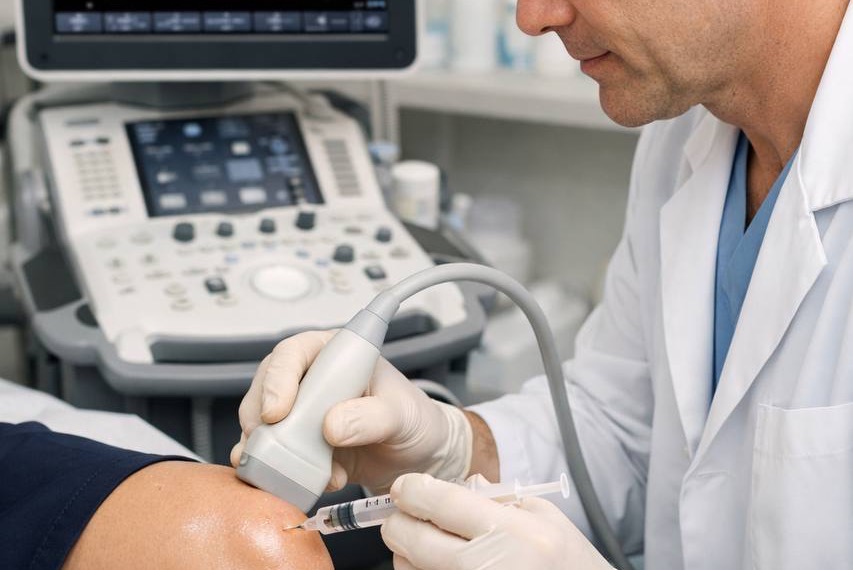
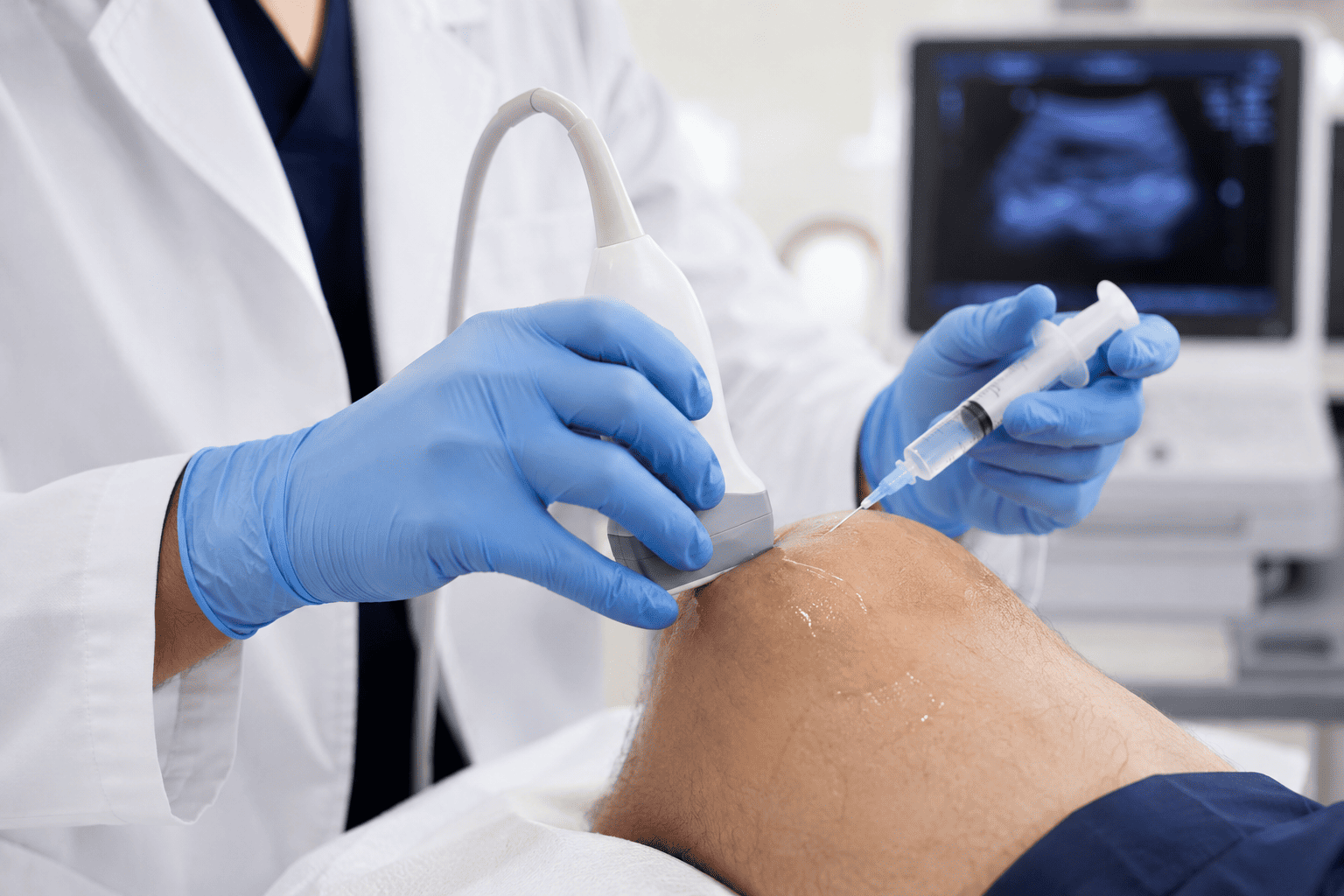
When conservative management does not provide adequate relief — or when pain is severe enough to prevent engagement with physiotherapy — targeted injection therapies offer an important next step. At Joint Care London, all injections for tennis elbow are performed under real-time ultrasound guidance, ensuring precise placement at the site of tendon pathology.
Corticosteroid (Steroid) Injection
Corticosteroid injection has historically been the most widely used injection treatment for tennis elbow, providing rapid and often dramatic short-term pain relief by suppressing local inflammation and reducing tendon irritation. A small amount of steroid and local anaesthetic is injected directly at the lateral epicondyle, guided by ultrasound.
However, the evidence on steroid injections for tennis elbow presents an important nuance: while they are highly effective at reducing pain in the short term (at 6–8 weeks), multiple studies have shown that outcomes at 12 months and beyond are inferior to physiotherapy alone — and repeated steroid injections may weaken tendon tissue over time.
This means steroid injections are best used strategically: to provide short-term pain control that enables a patient to engage with physiotherapy, rather than as a standalone or repeated treatment. We typically recommend limiting steroid injections to the lateral elbow to 1–2 occurrences, with structured rehabilitation forming the foundation of recovery.
What to expect: Pain relief typically begins within 3–7 days and lasts for weeks to several months.
Platelet-Rich Plasma (PRP) Injection
PRP is one of the most promising and increasingly well-evidenced injection treatments for chronic lateral epicondylalgia. A small amount of the patient's own blood is drawn, centrifuged to concentrate the platelets and their associated growth factors, and injected precisely into the area of tendon degeneration under ultrasound guidance.
Unlike steroid injections, which suppress activity in the tendon, PRP works with the tendon's biology — stimulating collagen synthesis, reducing abnormal vascularity, and promoting the tissue remodelling that characterises true tendon healing. This makes it particularly well-suited to the degenerative pathology underlying tennis elbow.
Multiple randomised controlled trials have now demonstrated that PRP produces superior long-term outcomes compared to steroid injection for chronic tennis elbow — with benefits continuing to improve over 3–6 months following the procedure.
What to expect: Some patients experience increased soreness for a few days after the injection as part of the biological response. Improvement typically emerges gradually over 4–8 weeks. A course of 1–2 injections is typically recommended, combined with a structured rehabilitation programme.
Best suited to: Patients with chronic tennis elbow (symptoms lasting more than 3 months), those who have had insufficient or short-lived benefit from steroid injection, or those seeking a treatment that supports genuine tendon healing rather than temporary pain suppression.
High Volume Injection (HVI)
In cases where diagnostic ultrasound reveals significant neovascularity (abnormal new blood vessel ingrowth) within the tendon — a feature of chronic tendinopathy — a high volume injection may be considered. This involves injecting a relatively large volume of fluid (saline and local anaesthetic, with or without a small amount of steroid) around the tendon, with the aim of disrupting the abnormal blood vessels and their accompanying nerve supply, which are thought to be a major pain generator in chronic tendinopathy.
HVI is more commonly used in lower limb tendinopathies (such as Achilles tendinopathy) but is also applicable in selected cases of refractory lateral epicondylalgia.
6. Extracorporeal Shockwave Therapy (ESWT)
Shockwave therapy uses high-energy acoustic waves directed at the site of tendon pathology to stimulate tissue repair and reduce pain. It is a non-invasive outpatient procedure, typically delivered in a course of 3–5 sessions. Evidence for ESWT in tennis elbow is generally positive, particularly for chronic cases that have not responded to physiotherapy or injection, and it is recommended in several national clinical guidelines as a second-line treatment before surgery is considered.
7. Surgical Treatment
Surgery for tennis elbow is rarely necessary — the vast majority of patients achieve full recovery with non-surgical management. It is considered only when symptoms have persisted for 6–12 months or more despite a genuine, sustained trial of conservative treatment and injection therapy.
The most common surgical procedure is a lateral release (also called debridement or Nirschl procedure), in which the degenerated portion of the ECRB tendon origin is excised and the surrounding tissue released. This can be performed as open or keyhole (arthroscopic) surgery. Outcomes are generally good, with the majority of patients achieving significant or complete pain relief, though recovery can take several months.
Tennis Elbow vs Golfer's Elbow — What's the Difference?
Golfer's elbow (medial epicondylitis) is the counterpart to tennis elbow, affecting the tendons on the inner side of the elbow (the medial epicondyle) — the attachment point of the forearm flexor muscles. Like tennis elbow, it is caused by repetitive loading and is not limited to golfers.
The key distinction is the location of pain: tennis elbow causes outer elbow pain, while golfer's elbow causes inner elbow pain. Both conditions are managed along similar principles, though their specific rehabilitation exercises differ. If you are unsure which condition you have, a clinical assessment will quickly clarify the diagnosis.
Frequently Asked Questions: Tennis Elbow
Can I still exercise with tennis elbow?
Yes — with modification. Complete rest is counterproductive and prolongs recovery. Low-impact aerobic exercise (walking, cycling) is generally fine. Activities involving gripping or wrist extension under load should be reduced initially, then gradually reintroduced as part of a structured rehabilitation programme.
Should I use ice or heat on tennis elbow?
Ice is most helpful during acute painful episodes or after provocative activity to reduce local irritation. Heat can help relax the forearm musculature before exercise or physiotherapy. Both can be used as needed for symptomatic relief.
How many steroid injections can I have in my elbow?
We generally recommend limiting steroid injections to the lateral elbow to 1–2 in total. The short-term benefit of steroid injections for tennis elbow does not outweigh the potential risks of tendon weakening and inferior long-term outcomes associated with repeated injections. If you have already had steroid injections without sustained benefit, PRP is likely to be a more appropriate next step.
Is tennis elbow serious?
Tennis elbow is not a dangerous condition and does not cause permanent damage if properly managed. However, it can be significantly debilitating — affecting the ability to work, exercise, and carry out basic daily activities. Without appropriate treatment, it can persist for 1–2 years or recur repeatedly. Early, targeted treatment leads to faster and more complete recovery.
Will tennis elbow come back after treatment?
Recurrence is possible, particularly if the underlying load management and technique issues are not addressed alongside symptom treatment. Completing a full rehabilitation programme and making appropriate modifications to the provocative activity are the most important factors in preventing relapse.
Can I get a tennis elbow injection at Joint Care London?
Yes. We offer both steroid and PRP injections for tennis elbow, performed under real-time ultrasound guidance at our clinics in Notting Hill and Golders Green. Appointments are typically available within days. Contact us to arrange a consultation.
Tennis Elbow Assessment and Treatment at Joint Care London
At Joint Care London, we provide rapid-access assessment and treatment for tennis elbow and other elbow conditions. Whether you are in the early stages and looking for guidance on rehabilitation, or have been suffering for months and are seeking injection therapy, our experienced musculoskeletal doctors can help you understand your diagnosis and find the most effective path to recovery.
All injections are performed under real-time ultrasound guidance, ensuring precise, safe delivery of treatment to the exact site of pathology. We offer both steroid and PRP injections for lateral epicondylalgia, with clear, honest advice about which option is most appropriate for your specific circumstances.
If elbow pain is affecting your work, your sport, or your daily life, contact us today to arrange a consultation at our Notting Hill or Golders Green clinic.